Uncategorized

Where Stress Settles: Caring for the Body and Mind Together

2026-05-14T16:34:16+00:00May 14th, 2026|Uncategorized|

Mental health is often treated separately from the body. Mental health is an internal, invisible experience shaped by thoughts and emotions. But in everyday life, that separation doesn’t really hold up. The body and mind are constantly interacting and influencing each other in ways that are both subtle and physical.

For many people, this connection becomes most noticeable through tension or discomfort. A stiff neck at the end of a long day. Shoulders that feel tight without a clear reason. Jaw clenching during stressful moments. A persistent ache in the lower back or hips.

These patterns aren’t random. They’re often the body’s way of responding to an ongoing mental and emotional load.

How stress shows up in the body

Stress isn’t just something we think about, it’s something we carry.

When daily pressures build up, the body adapts. Muscles may tighten, posture can shift, and movement becomes more restricted over time. Without regular opportunities to release that tension, it tends to settle into familiar areas:

  • Neck and shoulders: often linked to screen use and sustained focus
  • Jaw: where clenching or grinding can happen unconsciously
  • Mid and lower back: especially with prolonged sitting or reduced movement
  • Hips: which can become tight from inactivity or repetitive positions

Daily routines play a big role. Long hours at a desk, frequent phone use, and limited variation in movement can reinforce these patterns. Add in ongoing stress, and the body has fewer opportunities to fully relax and reset.

The two-way relationship

Just as mental stress can lead to physical tension, physical discomfort can also affect how we feel day-to-day.

When the body feels stiff, sore, or restricted, it can take more effort to focus, stay patient, or keep up with daily demands. Over time, this can wear on energy levels and overall resilience. Managing mental challenges often feels harder when the body is already under strain. Even small improvements in physical comfort, through movement, rest, or support can have a noticeable impact on mood and clarity.

Supporting movement and reducing tension

Taking care of both physical and mental well-being doesn’t usually require drastic change. More often, it’s about small, consistent habits that help the body stay adaptable:

  • Moving regularly throughout the day, even in short intervals
  • Adjusting posture and workspace setup
  • Becoming more aware of where tension builds (like shoulders or jaw)
  • Prioritizing rest and recovery

These kinds of changes can help reduce the accumulation of stress in the body and make your daily life feel more manageable.

Where chiropractic care fits in

Chiropractic care is a key component of this broader approach.

Chiropractic care focuses on how the body moves and functions, particularly the relationship between joints, alignment, and the nervous system. Rather than being a last resort, it can be used proactively to support better movement and reduce areas of restriction.

Through assessment and hands-on care, chiropractors work to:

  • Improve joint mobility and alignment
  • Reduce muscle tension and stiffness
  • Support more efficient movement patterns
  • Help the body respond more comfortably to everyday stress

When combined with healthy movement habits and lifestyle adjustments, this kind of support can make it easier to stay active, maintain posture, and prevent tension from building up over time.

Paying attention early

One of the most useful shifts is learning to notice early signs of strain. Tightness, fatigue, recurring aches, or even subtle changes in posture are often signals, rather than something to push through indefinitely.

Responding to these signals early, whether through movement, rest, or supportive care, can help prevent them from becoming more limiting.

A more connected approach to well-being

Stress is part of modern life, but how it shows up in the body, and how long it stays there, can change.

When the body feels more mobile and supported, it’s easier to think clearly, stay present, and handle daily challenges. Taking a more connected approach to physical and mental health doesn’t mean doing everything at once. It means paying attention, making small adjustments, and using the right kinds of support when needed.

Chiropractic care is a well-rounded approach to maintaining both physical comfort and overall well-being. Because managing what’s on your mind is simply easier when your body isn’t carrying more tension than it has to.
Travel without aches and pains – tips from Canadian chiropractors’

2026-04-13T16:33:34+00:00April 13th, 2026|Uncategorized|


Traveling can be an exciting adventure, but the journey itself often comes with its own set of challenges for your body. Whether you’re walking through terminals, running to your gate, sitting for extended periods, or lifting heavy luggage, the combination of muscle fatigue, joint stiffness, and travel stress can make you feel worn out before you even reach your destination or in some cases, your flight. As chiropractors, we understand the toll that travel can take on your body and have suggestions on how to improve your comfort from the moment you step into the airport, to when you reach your destination.

Let’s start with when you arrive at the airport. You may have been sitting in a cab or train for some time and are now going to be waiting in security lines and walking through the terminal. We all know that walking through airports is no easy feat, especially when towing along your luggage. Stretching your hip flexors while waiting in line can help keep your stride comfortable and reduce the risk of hip or lower back pain.


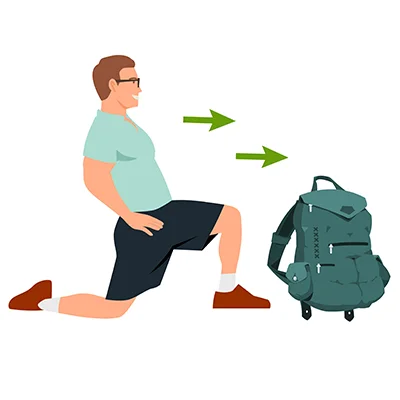
1. A hip flexor stretch before a long distance walk through the terminal

How to do it: Find an area with some open space and stand straight with your arms at your sides. Place your hands on your hips. Take a step forward with your right foot so you are standing in a split stance. Lower your right knee so it is bending at a 90-degree angle. With your left leg extended straight back behind you, you should feel a stretch in the left hip. Hold this position for 20-30 seconds, then switch legs.

Chiropractic Tip:
Even if you’re wearing running shoes, keeping your strides shorter can help to reduce the amount of force to your heels, feet, legs and back.

You have now made it through the terminal and loaded up on snacks and reading materials while you wait to board the flight. After showing your boarding pass to the airline staff, you are finally directed to your seat. You packed your carry-on lightly, but lifting your luggage to the overhead compartment can potentially strain your upper or lower back, especially if you’re not used to the movement or the weight of your bag. In addition to bracing your core and bending your knees prior to lifting, try this upper back stretch to help open up your shoulders and thoracic (mid-back) spine.


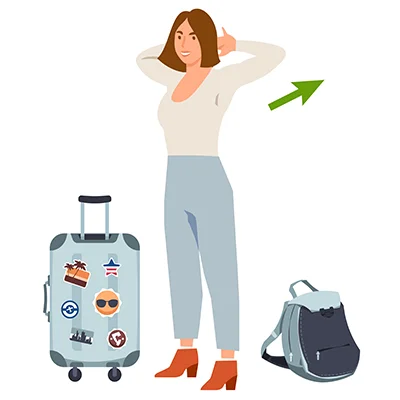
2. Prepare to lift your luggage into the overhead compartments with this upper back stretch

How to do it: Stand with your feet shoulder-width apart. Interlace your fingers behind your head and gently pull your elbows back, opening up your chest. Take a deep breath in, and as you exhale, gently arch your upper back, lifting your chest toward the ceiling. Hold this stretch for 20-30 seconds, feeling the tension release from your upper back.

Reminder! If you’re carrying a shoulder bag, remember to switch sides throughout your travels to distribute the load between your left and right shoulders.

You have now found your seat, buckled in and are feeling drowsy with the hum of the flight. Regardless of whether you brought a neck pillow or rolled up a sweater to make an impromptu cushion for your neck, sleeping in an awkward position on a plane can leave your neck feeling sore and stiff. Neck pillows may be helpful in reducing the amount of tilt your neck undergoes while you sleep, but you still may wake up feeling sore. Switching sides and positions as frequently as possible can help distribute the tension, as well as performing this gentle neck stretch when you wake up.


3. A neck stretch after your snooze on the plane

How to do it: Sit up straight in your seat and slowly tilt your head to the right side, bringing your ear toward your shoulder. Use your right hand to gently pull your ear closer to your shoulder, deepening the stretch. Take some slow, deep breaths while you hold the stretch for 20-30 seconds, then switch to the left side. Be sure to keep your shoulders relaxed throughout the stretch.

You are almost there! You have one layover to get to before your final destination. After sitting for a couple hours on the first flight, retrieving your carry-on luggage, then rushing to your next gate, you may start feeling some stiffness in your low back. Muscle cramps can also be common once you get up and start moving again after prolonged sedentary periods. Here is one way to work through your low back tension to keep travelling comfortably!


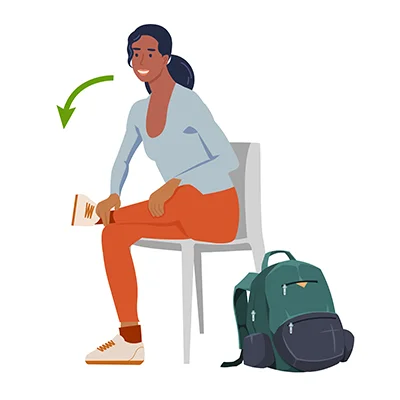
4. Try this lower back stretch after that long flight or layover

How to do it: Sit on the edge of your seat with your feet flat on the floor. Place one ankle over the opposite knee, forming a figure four with your legs. Gently lean forward, keeping your back straight, until you feel a stretch in your lower back and hips. Hold this position for 20-30 seconds, then switch sides.

Finally, you finished reading the last chapter of your novel as your flight lands at your destination. The thoughts of new foods and sightseeing keep your exhaustion at bay and you feel almost instantly rejuvenated! That is, until you see the line up for customs. Standing in long security lines or waiting for your flight can lead to discomfort in your back. A full back stretch can help relieve this muscle fatigue and tension, and keep you feeling physically refreshed.


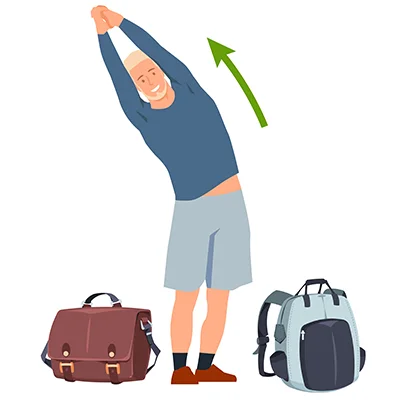
5. Stretching the full back while you’re standing in line

How to do it: Stand with your feet shoulder-width apart. Reach your arms overhead and clasp your hands together. Slowly lean to one side, stretching through the entire side of your body. Hold this position for 20-30 seconds, then switch to the other side. Finally, bend forward in attempt to touch your toes and roll your back up to stand up straight.

Chiropractic Tip: Research recommends standing up to move once every hour to reduce common areas of stiffness and muscle aches. When it is safe to do so, stand up and move for a few minutes!1


And you made it! By incorporating these simple stretches into your travel routine, you can help prevent common aches and pains associated with long journeys, whether you’re heading to the destination of your dreams or looking forward to returning to the comfort of your own home. A little bit of stretching can go a long way in keeping you comfortable and ready to enjoy your trip to the fullest.

Don’t forget, with over 9,000 chiropractors across Canada, you’re never far from expert care to provide additional MSK support wherever you land!

1. Van den Heuvel, S. G., et al. (2003). Ergonomics and musculoskeletal disorders: the role of physical activity breaks in the workplace. Journal of Occupational and Environmental Medicine, 45(6), 529-53


Go to Top